- Color Index Abbreviationref
- PB 31
- CI Generic Nameref
- PB 31
- CI Constitution No.ref
- 77437
- Categoryref
- Blue
- Opacity Classref
- Semi-opaque to opaque
- ASTM/ISO Refsref
- ASTM D4303
- Lightfastnessref
- I (Excellent)
- Oil Absorptionref
- 20–30 g/100g
background
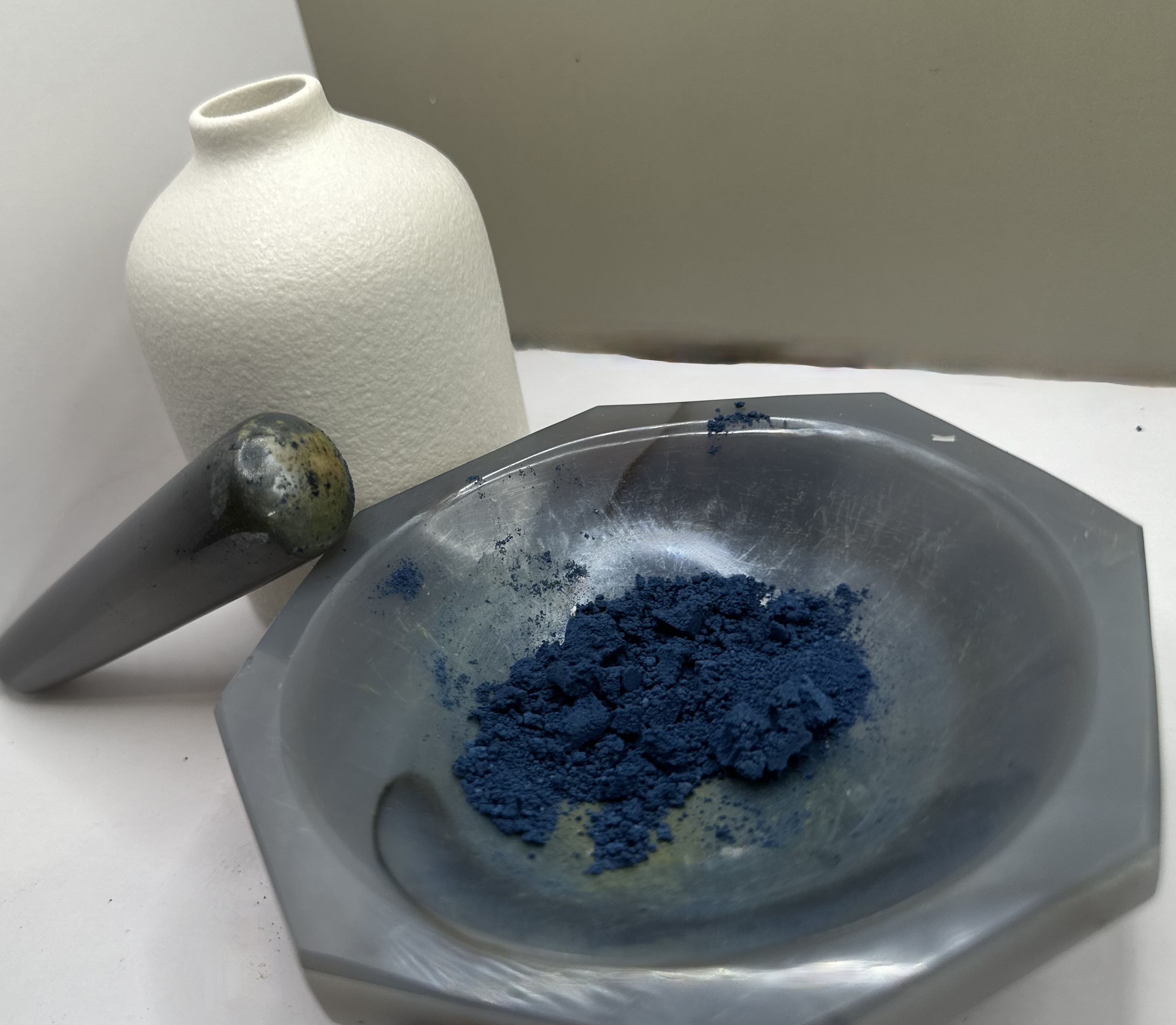
Egyptian Blue is a synthetic inorganic pigment defined by its crystal structure rather than its provenance. Chemically, it is a calcium copper silicate (CaCuSi₄O₁₀), commonly referred to as cuprorivaite, with a layered Si₄O₁₀ silicate framework closely related to later copper silicate pigments. Its blue color arises from crystal-field splitting of square-planar Cu²⁺ centers embedded within a rigid silicate lattice, with optical behavior governed by extended lattice-scale electronic structure rather than molecular chromophores.
At the level of solid-state behavior, Egyptian Blue exhibits anisotropic physical and optical properties characteristic of layered silicates. Experimental studies report low thermal conductivity dominated by phonon scattering, strong coupling between Cu²⁺ electronic states and the host lattice, and a characteristic near-infrared luminescence arising from lattice-enabled electronic transitions. Optical and spectroscopic investigations show that neither its visible color nor its infrared emission can be fully explained by isolated CuO₄ units, but instead depend on long-range internal crystal fields and structural coherence that shift electronic transitions relative to simpler copper oxides or silicates.
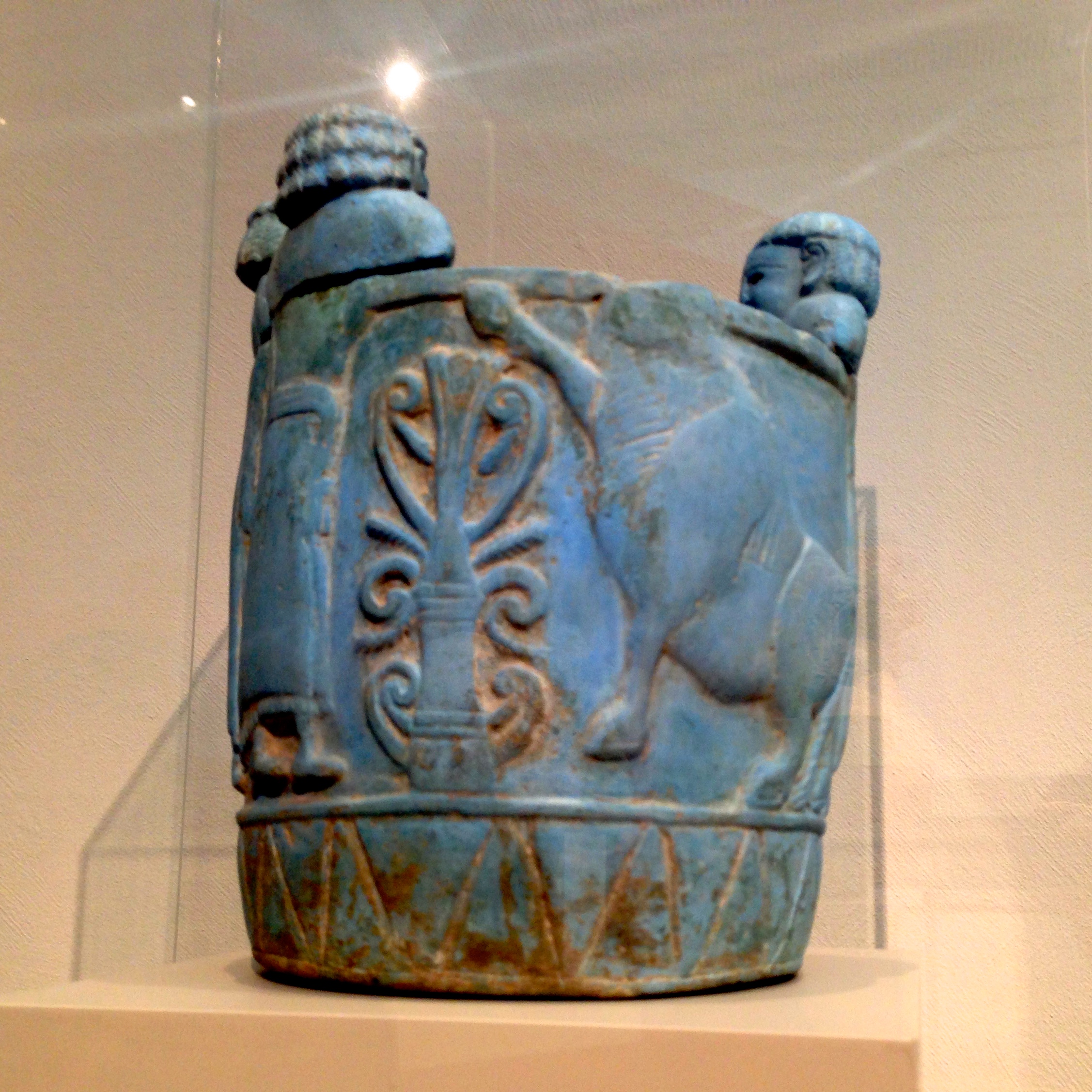
Historically, Egyptian Blue was synthesized beginning in the third millennium BCE in Egypt and the broader Mediterranean world using high-temperature kiln processes and mineral precursors. It represents the earliest known example of deliberate, repeatable pigment synthesis. Its extensive use in wall painting, sculpture, ceramics, and architectural decoration over multiple millennia reflects continuity of material performance rather than reliance on fragile organic dyes. Modern analytical rediscovery of Egyptian Blue reflects renewed interest in its intrinsic solid-state properties, including its unusual optical behavior, rather than the recovery of a lost technique.
safety
- GHS Classificationref
- Not classified as hazardous under CLP/GHS
- Hazardsref
- Inhalation (primary): respirable dust; mechanical eye/skin irritation; avoid ingestion
- Recommended PPEref
- N95 minimum; P100 for milling/transfers; nitrile gloves; safety glasses; lab coat
- Exposure Notesref
- Wet methods preferred; avoid dry sweeping; wash hands after handling
- Storageref
- Sealed container, cool/dry
- Disposalref
- Dispose as inorganic pigment waste per local regulations
ec data (coming soon)
The following measurements are pending elemental color laboratory analysis:
- GHS Classification
- Hazards
- Recommended PPE
- Exposure Notes
- Storage
- Disposal
- Chemical Formula
- Crystal Structure
- Particle Size
- Refractive Index
- Specific Gravity
- Phase / Identity
- Family
- Synthesis Class
- Hue Bias
- Opacity
- Scattering Regime
- NIR Response
- Fluorescence
- Oil Absorption
- Binder Compatibility
- Hardness
- Chemical Stability
chemical
- Chemical Formularef
- CaCuSi₄O₁₀
- Crystal Structureref
- Tetragonal
- Particle Sizeref
- 5–40 µm
- Refractive Indexref
- 1.59–1.63
- Specific Gravityref
- 3.0–3.1
- Phase / Identityref
- CaCuSi₄O₁₀ (cuprorivaite)
- Familyref
- Calcium copper silicate
- Synthesis Classref
- Solid-state / flux
optical
- Hue Biasref
- Cool blue, slight green bias
- Opacityref
- Semi-opaque to opaque
- Scattering Regimeref
- Mie-dominant
- NIR Responseref
- Strong NIR luminescence (~910 nm)
- Fluorescenceref
- Weak UV-A fluorescence
physical
- Oil Absorptionref
- 20–30 g oil / 100 g pigment
- Binder Compatibilityref
- Compatible with common binders (oil, acrylic, gum arabic, egg tempera, casein, fresco/lime)
- Hardnessref
- 5–6 Mohs
- Chemical Stabilityref
- High; stable to light, heat, and alkalis; may be affected by strong acids
.jpg)